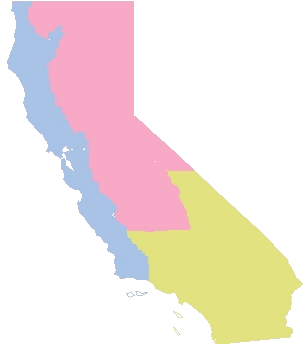
Three Californias 2011 - It's Time
In February 2005, over six years ago, an article appeared in the San Francisco Chronicle which included this observation:
I'm an optimist by nature and a Californian by upbringing. I truly believe there is something distinctly alluring about the state in and of itself -- not just the geography but the California of the mind, the ideas and dreams embodied in the notion of the place. There's a cultural climate that says here, new things can happen. Everyone's own private heaven awaits, whether it's the green arcadia of Humboldt County or the well-buffed bliss of San Diego.At the time, I saved that article because its writer, 2002 and 2003 Pulitzer Prize nominee John King, so clearly articulated the obvious I wanted to use it on the front page of the web site Three Californias.
But focus hard on the reality of 2005, and what we see is a golden state of dysfunction.
Bad enough that schools are in decline, and that budget deficits stretch as far as the eye can see. The underlying problem is the detachment between decision-makers and the results of their decisions. It is a state so large, hobbled by so many initiatives and expectations that not even a life-and-death issue jars the status quo.
That web site was set up in 2005 to provide a single place on line for people to find the long history of proposals to divide California, controversies that began when California was proposed for Statehood.
But more importantly, it is a web site that outlines the reasons why California no longer works as a single state and the logical for dividing the State into three new states.
Here we are in 2011. The State government is in an agonizingly deep financial crisis. Governor Jerry Brown, elected in November 2010, is running up and down the state trying to convince people to push for a tax increase that he cannot get through the Legislature. Everyone agrees that California is "ungovernable."
There is a story from nearly a quarter of a century ago, which may be apocryphal, about when that term was applied to the State:
Then-Sen. Pete Wilson was agonizing over whether to run for governor. Old pal [Stu] Spencer — a political advisor to presidents and governors, most notably Ronald Reagan — invited Wilson to his isolated Oregon ranch for some frank talk among the pines and manzanita, in front of a crackling fire.In a 2007 piece, columnist George Skelton of the L.A. Times wrote:
“You’ve got the best job in the world right now — senator from California,” Spencer told Wilson, as the sage recalls it. “I don’t know why’n hell you’d run for governor. California is ungovernable.”
Last week, I called Spencer — now 80 and semiretired — at his Palm Springs home and asked whether he still believes the state is ungovernable....If you think dividing the state is a crackpot idea with no foundation, keep in mind proposals to divide California into more than one state date back to the time before California was admitted to the Union in 1850. In the first 150 years of statehood, there have been 27 serious proposals to split the state.
“The public is more polarized,” he said, “because we’re more diverse. We’ve got a bigger mass of bodies and we’re more diverse economically. People are divided about what they want....”
This leads to political “rigidness,” he added. “There’s not much unanimity or desire to compromise to reach a goal.
...People get despondent because they believe something should be done and they can’t get it done.”
And consider the underlying reason Brown is traveling around the state compared to this discussion of the push to split the state in the 1849 Constitutional Convention, before the State became a State:
…The representation from the southern districts in the constitutional convention was about one-fourth the number from the whole territory. Seven members of the convention were native-born Californians. The greater number of the other members had been in California but a short time.In 1859, the Legislature put matter to the voters in Southern California and a whopping 75% said create a separate state. But the Civil War distracted everyone. In the first 160 years of statehood, there have been 27 serious proposals to split the state.
It immediately became evident that the people of southern California did not desire to have their fortunes linked in civil government with the territory further north.
…William M. Gwin, in his Memoirs, says of the attitude of the convention: “When they met to organize, the members showed a strange distrust of the motives of each other from various sections. The old settled portions of California sent members to the convention to vote against the formation of a state government. They were afraid of the newcomers, who formed a vast majority of the voting population.”
Mr. Carrillo, a native Californian from the Santa Barbara district, …proposed that the country should be divided by running a line west from San Luis Obispo, so that all north of that line might have a State Government, and all south thereof a Territorial Government.
If the area that became the state was thought to be too diverse and too large to be a state by Californians in 1849 and 1859, and about every 6 years since then, maybe it is too diverse and too large to be governed as a single state.
Just maybe Jerry Brown should take a hard look while he's traveling around. Maybe "it is a state so large, hobbled by so many initiatives and expectations that not even a life-and-death issue jars the status quo," as King observed.
As Brown struggles to find support for his budget plan with particular emphasis on saving our educational system, California Watch has found that:
For nearly eight decades, California's landmark Field Act has governed the design and construction of public schools. But California Watch found a regulatory breakdown that raises questions about the safety of children in buildings throughout the state.What they found is that many schools have never been certified under the Field Act, the seismic building standards law for public schools enacted after the 1933 Long Beach earthquake.
The 1972 Alquist-Priolo Earthquake Fault Zoning Act, passed one year after the Sylmar quake in the San Fernando Valley killed more than 60 people and caused more than $500 million in damage, requires the California Geological Survey to map the earthquake hazard zones in the state.
As soon as the first maps were released in 1974, development and real estate interests began an incessant attack. Keep in mind that Brown was sworn in as Governor for his first term in 1975. According to the San Francisco Chronicle
"Realtors absolutely hated it," said Earl W. Hart, manager of the Alquist-Priolo program from its inception until the mid-1990s.The Chronicle article also notes:
In one three-week period in October 1974, Hart reported receiving 52 complaints from real estate agents, developers, property owners and others. During the commotion, the state geologist at the time, James E. Slosson, refused to "water down" the hazard zone maps, notes from the State Mining & Geology Board show.
But in late 1975, Slosson resigned and was replaced by Thomas E. Gay Jr., who began re-examining the fault zone maps. By February 1976, the Fault Evaluation Program was born.
Hart's team no longer included faults without significant ground movement in the past 11,000 years. Previously, the state had used the scientific standard of 2 million years - criteria still used by other states - to draw the zones.
...As a result of the changes, many fault zones shrank or disappeared from the Alquist-Priolo maps.
In the San Francisco Bay Area, 13 maps had fault zones that were removed, according to an internal state geologist report. Out of 708 maps released over the past three decades, the state geologist's office has redrawn 161.
...The Alquist-Priolo law requires school districts to hire geologists to make a detailed assessment of nearby earthquake faults before renovating or building in these zones. Builders, teachers, children and parents are left in the dark without those assessments.The question for any reasoning Californian is why do we want to continue government in this fashion.
Still, several school districts in these hazard zones have started and completed building projects in recent years without investigating fault-line hazards, records and interviews show.
Is it really important to give Brown his five year temporary tax increase extension to solve a fiscal problem created during his last stint as Governor to put school children in school buildings that are unsafe because of his management during his last stint as Governor? Are we really this stupid?
Well, yes we are. As John King said six years ago:
The underlying problem is the detachment between decision-makers and the results of their decisions. It is a state so large, hobbled by so many initiatives and expectations that not even a life-and-death issue jars the status quo.It's 2011, it's time to seriously consider dividing the state into Three Californias if for no other reason it will give us all a fresh start on state and local government.
posted by Michael O'Faolain - at 5:08 PM
|
0 comments